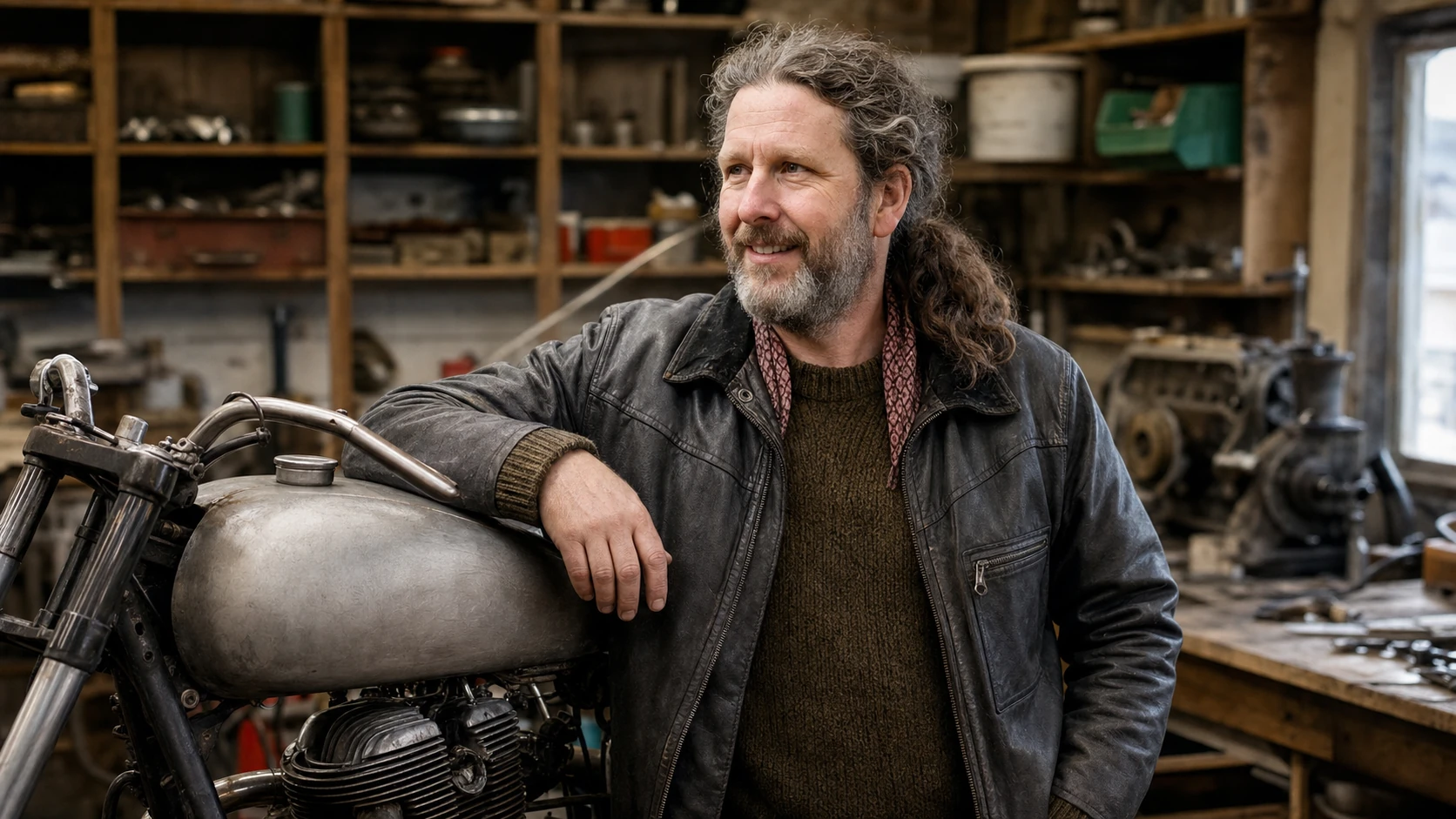
Sam Lovegrove is a British mechanical engineer, classic-motorcycle restorer, and television personality best known for working alongside Henry Cole on Shed & Buried. His calm manner and practical skill made him a distinctive presence in programmes built around neglected motorcycles, unusual vehicles, workshop repairs, and mechanical history.
Television brought Lovegrove to a wide audience, but his career began long before cameras entered his workshop. He has worked in motorsport gearbox design, vehicle construction, hydrogen fuel-cell development, and specialist engineering. His later reputation grew from restoring rare motorcycles and making replacement components that could no longer be bought.
Public interest in Lovegrove also increased when he appeared less often in newer episodes connected with Henry Cole. There is no confirmed evidence that illness, an accident, or a personal dispute caused his absence. The official explanation is that he became occupied with demanding restoration projects, including rare Brough Superior motorcycles damaged in a museum fire.
Early Life and Interest in Motorcycles
Sam Lovegrove’s exact date of birth and birthplace have not been publicly confirmed. A profile published by Classic Bike in March 2015 described him as 42 years old. That would place his birth around 1972 or early 1973 and make him approximately 53 or 54 in August 2026, depending on his birthday.
Lovegrove became interested in motorcycles at an early age. He has said that he owned motorcycles from around the age of 10 and began helping in local garages when he was about 12. His early experience came through repairing, adapting, and assembling machines rather than simply riding them.
One of his first projects combined an AP50 rolling chassis with an SS50 engine. He also used a larger C70 barrel and made his own exhaust, producing a machine from whatever suitable parts and materials were available. The motorcycle was basic, but he succeeded in making it road legal and rode it for about two years.
That early project anticipated the approach that later defined his career. Lovegrove has often worked with incomplete machines, missing parts, and mechanical combinations that require original thinking. He is interested not only in how a vehicle looks, but also in how each component affects its operation.
Education and Early Engineering Work
Before entering higher education, Lovegrove worked as a mechanic and attempted to run a garage restoring old cars in Cornwall. He later acknowledged that the business was unsuccessful, but the experience gave him direct knowledge of repairs, customers, costs, and the difficulty of earning a living from specialist work.
At the age of 21, he began studying mechanical engineering at Oxford Brookes University. Available accounts indicate that he completed three years of a planned four-year course before receiving an employment opportunity in motorsport. It is not publicly confirmed whether he later completed the final year or received a degree.
Lovegrove’s practical background helped him move into professional engineering. He worked for a company involved in motorsport gearbox design, giving him experience with precision components and machinery built to withstand high loads. Gearbox work requires accurate measurement, careful material choices, and an understanding of how small errors can lead to major failures.
He later worked in areas that included paint application and vehicle construction. His career also involved Aston Martin, although the exact title, duration, and scope of that work have not been fully documented in public profiles.
Hydrogen Fuel-Cell Engineering
One of the less widely known parts of Lovegrove’s career involved hydrogen fuel-cell vehicles. He eventually became head of design at a company developing fuel-cell systems at a time when the technology was still expensive and commercially uncertain.
In 1999, the company built three hydrogen-powered trucks and developed a taxi for testing. Lovegrove described the taxi as using a 9-kilowatt fuel-cell package and having a range of about 70 miles. The work required engineers to package unfamiliar technology into road vehicles while dealing with limits in power, cost, weight, and fuel storage.
The business later entered administration. By that stage, Lovegrove’s work had moved away from hands-on engineering and toward management, meetings, and frequent travel. He said that he was working long hours and faced a journey of roughly 276 miles between his home and workplace.
Family life influenced his next decision. Lovegrove wanted to spend more time at home with his children rather than continuing a demanding schedule built around offices, airports, and a long commute. He left that environment and returned to specialist engineering in Cornwall.
Building a Workshop Career in Cornwall
Lovegrove began earning money by producing parts for vintage engines and motorcycles from his Cornish workshop. His work included making gears, camshafts, and other components that were no longer available through normal suppliers. He used computer-aided design, including AutoCAD, while also relying on traditional measuring, machining, filing, and fitting skills.
This type of work demands patience because early motorcycles rarely arrive with perfect records or complete factory drawings. A restorer may need to study surviving pieces, wear marks, similar machines, and period photographs before recreating a missing component. Even a small error in dimensions or timing can damage an engine.
Lovegrove became especially interested in early British motorcycles. These machines often expose their mechanical systems rather than hiding them behind bodywork and electronics. Their hand controls, open components, basic brakes, and individual starting procedures require more involvement from both the rider and the engineer.
One of his long-term motorcycles is an Ariel VB600 side-valve. He bought it at the age of 21 after finding it advertised as boxes of parts for £300. Although he later went through periods in which he lost many possessions, he kept the Ariel and came to regard it as one of his most comfortable and dependable motorcycles.
The bike included several non-standard features, such as adapted handlebars, a Harley-Davidson seat, and a rear mudguard made from an old Water Board sign. Lovegrove did not remove every alteration simply to create a factory-perfect display piece. His approach accepts that useful changes can become part of a motorcycle’s history.
The Homemade Ariel V-Twin
Lovegrove’s homemade Ariel V-twin is one of the strongest examples of his engineering ability. Ariel never manufactured the exact 90-degree V-twin engine that he built. He created it by combining and modifying crankcases from two 1950s Ariel VB600 single-cylinder engines.
At the start of the project, he did not have access to a milling machine or lathe. He relied on hacksaws, files, jigs, marking blue, and repeated measurements to cut and join the crankcases. His first attempt did not work, but he corrected the design and continued until the combined structure operated successfully.
The engine used a mixture of Ariel components, adapted Harley-Davidson connecting rods, and bearing arrangements that Lovegrove made himself. His aim was not to create a modern-looking custom motorcycle. He wanted the finished machine to appear as though Ariel might have built it during the period.
The project shows how Lovegrove combines imagination with restraint. He can create something that never existed while still respecting the materials, proportions, and engineering methods associated with an older manufacturer. That ability later made him valuable on historically important restoration and competition projects.
Brough Superior and the Baby Pendine
Lovegrove developed a close association with Brough Superior, one of the most respected names in British motorcycle history. He has worked on rare machines from the marque and has been described in Brough Superior heritage material as a collector and leading authority on their restoration.
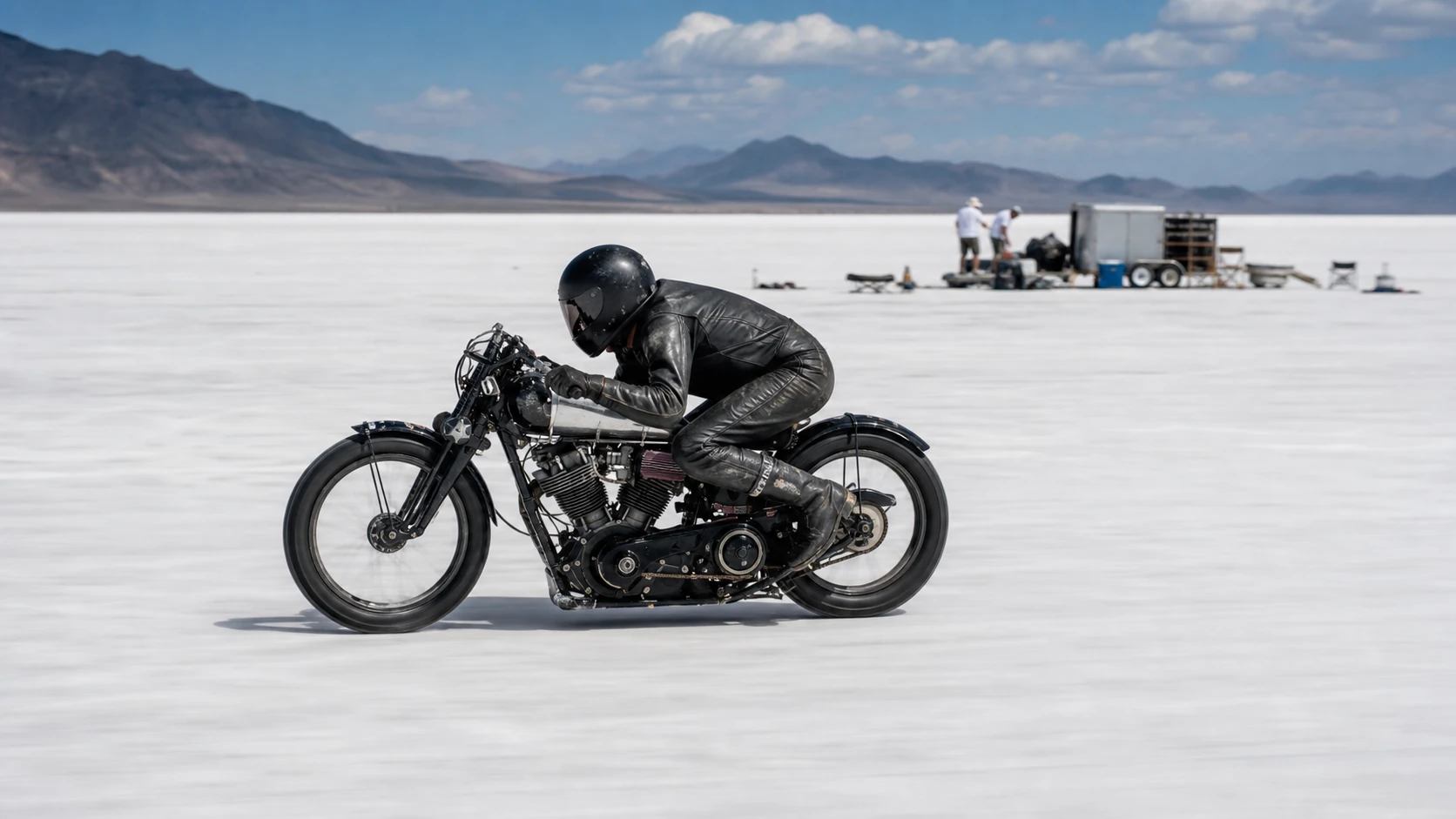
His work on the Brough Superior Baby Pendine helped strengthen his reputation beyond television. The 750cc JAP-engined motorcycle was prepared for land-speed competition at the Bonneville Salt Flats in Utah. Lovegrove rebuilt and tuned the engine, constructed the rolling chassis from bare tubes, and completed the paintwork.
The project took about 14 months. It required more than creating a visually accurate motorcycle because the machine had to meet competition rules and remain dependable at sustained high speed. Lovegrove needed to consider gearing, fuel mixture, ignition timing, handling, and the stress placed on an old-style V-twin engine.
At Bonneville in August 2013, the Baby Pendine achieved two FIM records and two AMA records. Motorcycle journalist Alan Cathcart recorded an average speed of about 101.328 mph in one class, while Henry Cole achieved an AMA record averaging 99.780 mph in another.
The motorcycle’s reliability was as important as its speed. Reports from the event indicated that it completed its runs with limited adjustments to jetting, gearing, and timing. That performance reflected Lovegrove’s preparation and helped establish his professional relationship with Cole.
Television Career With Henry Cole
Sam Lovegrove became widely known through programmes presented by Henry Cole. Their partnership worked because their personalities and responsibilities differed. Cole brought enthusiasm, negotiation, and ambitious plans, while Lovegrove assessed the machinery and dealt with the consequences in the workshop.
Their early work included preparing motorcycles for speed-related television projects. Lovegrove also worked on a Triumph Tiger 80 that developed engine trouble during testing. After the engine partly seized, he repaired the damage, changed the piston clearance, and continued testing the next day.
Shed & Buried
Shed & Buried follows Cole and Lovegrove as they visit garages, barns, sheds, and private collections in search of neglected vehicles and mechanical objects. The pair assess possible purchases, negotiate with owners, and decide whether a machine can be repaired and sold.
Lovegrove’s contribution often becomes most visible after the purchase. A motorcycle or vehicle may appear complete while hiding a seized engine, damaged gearbox, missing components, or years of poor modifications. He determines whether it can be recommissioned quickly or whether the likely repair cost makes the project impractical.
His understated manner became part of the programme’s appeal. He rarely treated a repair as easy before opening the engine or inspecting the damage. Viewers saw him pause, measure, and question a plan before committing time and materials to it.
The Motorbike Show and Other Programmes
Lovegrove has also appeared in The Motorbike Show, contributing to motorcycle restorations, competition builds, and historical features. Projects shown across the programmes have included Harley-Davidson and BSA motorcycles, engine work, road trips, and machines prepared for record attempts.
In Find It Fix It Drive It, he used his engineering skills to help rebuild unusual vehicles for practical challenges. Junk & Disorderly followed Cole, Lovegrove, and other specialists as they bought objects at auctions and autojumbles before repairing or reselling them.
These programmes did not create Lovegrove’s technical authority. They gave viewers access to work he had already been doing professionally. His screen identity remained closely connected to his real workshop skills rather than a scripted television character.
What Happened to Sam Lovegrove?
Viewers began asking about Lovegrove after he appeared less frequently in some newer programmes. Several unsupported explanations circulated online, including claims of illness, accidents, retirement, and a breakdown in his friendship with Henry Cole.
No reliable public evidence supports those claims. Henry Cole’s official website explained that Lovegrove had been busy restoring two Brough Superior motorcycles badly damaged in the 2021 fire at the Top Mountain Crosspoint Motorcycle Museum in Austria.
One of the projects involved a rare 1932 four-cylinder Brough Superior that had suffered severe fire damage. Restoring a burned historic motorcycle can be harder than rebuilding a normal incomplete machine. Heat may distort metal, weaken components, destroy finishes, and erase clues about how missing sections were originally made.
The project helps explain why Lovegrove’s television appearances became less regular. It required years of specialist work and careful reconstruction rather than the faster turnaround expected by a weekly television production.
There is also no confirmed evidence of a feud with Cole. The two continued to appear together publicly, and Cole featured Lovegrove in a Cornwall segment of The Motorbike Show. Lovegrove also became the first subject of Cole’s extended online interview series, Shed Talk.
Recent Work and Current Status
Lovegrove remained professionally active in 2026. He appeared as an engineering assistant in the five-part UKTV series Dom Chinea’s Cornish Workshop. The programme followed craftsman Dom Chinea as he created a new workshop in west Cornwall and took on repair and construction projects.
Lovegrove helped with work involving church bells, a beach-rescue quad bike, a drift car, a vintage motorcycle, and a workshop sign cast using Cornish tin. The role introduced him to an audience beyond Henry Cole’s programmes while keeping the focus on engineering and problem-solving.
His appearance in Shed Talk also gave viewers a longer account of his life, motorcycles, and working relationship with Cole. These developments show that Lovegrove has not retired or disappeared. His public work has become more selective while large restoration projects continue to occupy much of his time.
Partner, Children, and Private Life
Lovegrove has confirmed that he has children. He referred to them while discussing his decision to leave a demanding engineering-management job and work closer to home. Their names, ages, and exact number are not publicly confirmed.
A 2015 profile also referred to him travelling through France on an Ariel motorcycle with his “missus.” The term may refer to a wife or long-term partner, but the article did not identify her or confirm their legal marital status.
Lovegrove has kept his family outside his television identity. There is no dependable public record of a marriage date, spouse’s name, or detailed family history. Biography sites that provide precise claims about his partner or children often fail to identify a credible source.
Net Worth and Income Sources
Sam Lovegrove’s net worth has not been publicly confirmed. Figures repeated by celebrity biography websites are estimates and are not supported by disclosed television contracts, business accounts, property records, or statements from Lovegrove.
His likely income sources include television appearances, specialist engineering, motorcycle restoration, component manufacturing, and privately commissioned projects. Rare restoration work can involve valuable machines, but the value of a motorcycle in his workshop does not represent his personal wealth.
A restorer may spend months rebuilding a collector’s motorcycle without owning it or sharing in its eventual sale value. For that reason, assigning Lovegrove a precise fortune based on the motorcycles associated with him would be misleading.
Public Image and Reputation
Lovegrove’s reputation rests on competence rather than celebrity behaviour. He became popular without sharing much of his private life or adopting an exaggerated television personality. His appeal comes from the impression that he would approach a mechanical problem in the same careful way whether a camera was present or not.
He also represents a link between modern design training and traditional workshop practice. His background includes computer-aided design, motorsport, experimental vehicles, manual machining, and early motorcycle technology. Few television engineers move as naturally between those different kinds of work.
His restorations also preserve knowledge that could otherwise disappear. When replacement parts no longer exist, engineers such as Lovegrove must understand why the original component was shaped a certain way and how it interacted with the rest of the machine. The finished motorcycle is only one result; the survival of those skills matters too.
Frequently Asked Questions
Who is Sam Lovegrove?
Sam Lovegrove is a British mechanical engineer, classic-motorcycle restorer, and television personality. He is best known for appearing with Henry Cole in Shed & Buried, The Motorbike Show, Find It Fix It Drive It, and Junk & Disorderly.
How old is Sam Lovegrove?
His exact birth date is not publicly confirmed. A March 2015 profile described him as 42, suggesting that he was born around 1972 or early 1973 and is approximately 53 or 54 in August 2026.
What happened to Sam Lovegrove on Shed & Buried?
Lovegrove appeared less often because he was occupied with specialist restoration work, including two Brough Superior motorcycles damaged in a 2021 museum fire. There is no confirmed evidence that illness, an accident, or a dispute with Henry Cole caused his reduced screen presence.
Are Sam Lovegrove and Henry Cole still friends?
Their continued appearances and collaborations indicate that they remain friends and professional colleagues. Cole visited Lovegrove for The Motorbike Show and selected him as the first guest for the Shed Talk interview series.
Is Sam Lovegrove married?
His marital status is not publicly confirmed. An older profile referred to his partner as his “missus,” but it did not identify her or establish whether they were legally married.
Does Sam Lovegrove have children?
Yes, Lovegrove has publicly referred to having children. Their names, ages, and exact number have not been reliably disclosed.
What is Sam Lovegrove doing now?
As of 2026, Lovegrove remains active in engineering, restoration, and television. He appeared in Dom Chinea’s Cornish Workshop, took part in Shed Talk, and continued work on rare historic motorcycles.
Conclusion
Sam Lovegrove built his public reputation through television, but his real career was formed in garages, design offices, motorsport workshops, and a specialist engineering shop in Cornwall. His knowledge comes from both formal study and decades of practical trial, failure, repair, and refinement.
His reduced presence in some programmes did not mark a confirmed retirement or personal crisis. It reflected the slow nature of serious restoration work, especially when the machines involved are rare, badly damaged, and historically important.
Lovegrove occupies an unusual position in factual television. He is recognisable without behaving like a conventional celebrity, and his family and finances remain largely private. What viewers know best is the part he has chosen to share: a patient engineer facing an old machine and finding a credible way to make it work again.